
SanatanAdhyayan
🎖 Based on traditional sources and standard scholarly editions.

Yuga Kaal: Hindu Cosmological Time Cycles

In Sanatana Dharma, time is not linear (with a beginning and an end), but fundamentally cyclical and infinite. Time behaves like seasons, repeating in massive cosmic epochs. The primary cycle is the Mahayuga (also called Chatur-yuga), which consists of four distinct Yugas (ages) characterized by a gradual decline in virtue (dharma), longevity, and wisdom, followed by automatic cosmic renewal.

One full Mahayuga spans exactly 4,320,000 human years. The transition between these ages is accompanied by a degradation of spiritual values, represented by the sacred bull of Dharma standing on four legs in the first age, and losing one leg with each subsequent epoch, until only a single leg remains in our current age, the Kali Yuga.
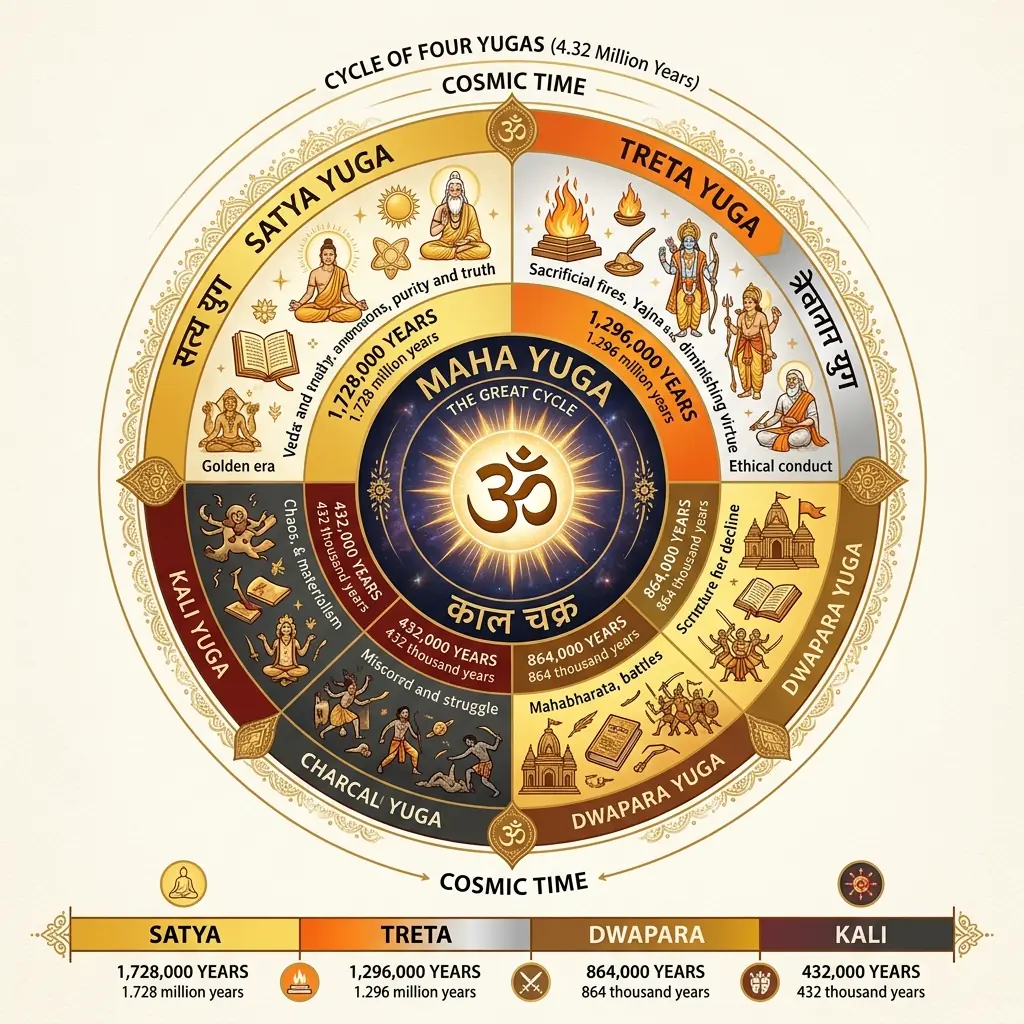
Yuga Cycle Diagram showing Satya, Treta, Dwapara, and Kali Yugas and their durations
The Cosmic Wheel of Yuga Kaal

The four Yugas cycle continuously like cosmic seasons within the 4,320,000-year Chatur-yuga (Mahayuga). Each age sees a proportional shift in duration (4:3:2:1 ratio) and dharma levels, culminating in a transition period and automatic spiritual reset.

Interactive Visual Timeline

Click on a Yuga card below to view detailed cosmological metrics, characteristics, key figures, and avatars.

Satya Yuga
1,728,000 Years
The Age of Truth and Perfection. Dharma stands on four legs. Direct communion with the divine.
Treta Yuga
1,296,000 Years
The Age of Rituals and Sacrifice. Dharma stands on three legs. Appearance of Lord Rama.
Dwapar Yuga
864,000 Years
The Age of Doubt and Ceremony. Dharma stands on two legs. Appearance of Lord Krishna.
Kali Yuga
432,000 Years
The Dark Age of Ignorance. Dharma stands on a single leg. Current materialist era.

Satya Yuga (Krita Yuga)

Duration: 1,728,000 human years

Dharma Level: 100% (4 legs of Dharma: Truth, Purity, Compassion, Austerity)

Average Lifespan: ~100,000 years

Core Characteristics: No diseases, no sorrow, no hatred, no pride. Human minds are pure, enabling direct realization of the supreme consciousness (Brahman). Meditation (Dhyana) is the primary spiritual process.

Major Avatars: Matsya, Kurma, Varaha, Narasimha

Key Figures: Vaivasvata Manu, The Saptarishis, Prahlada, Dhruva

The Cosmological Hierarchy

Hindu cosmology works with incredibly vast scales of time, matching modern astrophysics in terms of scale. A single Mahayuga is just a building block of larger cycles:

Mahayuga
4.32 Million Years
Composed of 4 Yugas in a 4:3:2:1 ratio (Satya, Treta, Dwapar, Kali). Includes transition periods (Sandhya and Sandhyansa).
Manvantara
306.72 Million Years
Spans 71 Mahayugas. Each Manvantara is ruled by a different Manu (progenitor). We are in the 7th Manvantara (Vaivasvata).
Kalpa (Day of Brahma)
4.32 Billion Years
Spans 14 Manvantaras (1,000 Mahayugas), representing a single day in the life of Brahma. Equal to the age of the Earth.

"Kaun tha Kab?" (Who was When?)

Filter through major deities, avatars, sages, and kings of Sanatana Dharma history based on the Yuga in which they appeared.

Filter by Era:
Sources and Editorial Approach

The information presented on this page is compiled from standard Sanskrit manuscripts, Gita Press editions, and critical academic compilations such as those from the Bhandarkar Oriental Research Institute (BORI). We prioritize accuracy and translation alignment with classical commentators (such as Adi Shankaracharya, Sayana, and Ramanujacharya) rather than modern interpretations.

FAQ

Frequently Asked Questions

We are currently in the Kali Yuga. Traditionally, this age began in 3102 BCE upon the departure of Lord Krishna from the earthly plane, marking the transition. As of 2026 CE, we are approximately 5,128 years into the 432,000-year total duration of Kali Yuga.
Dharma is represented as a sacred bull symbolising cosmic order. In Satya Yuga, the bull stands on all four legs: Truth (Satya), Purity (Shaucha), Compassion (Daya), and Penance/Austerity (Tapas). In Treta, Purity diminishes, leaving three legs. In Dwapar, Compassion reduces, leaving two. In Kali Yuga, only the leg of Truth (Satya) remains, though heavily challenged.
Hinduism rejects linear creation-destruction theories. When a Kali Yuga ends, it doesn't lead to absolute void, but rather initiates a transition back into a golden Satya Yuga. This process of creation (Srishti), preservation (Sthiti), and dissolution (Pralaya) repeats infinitely across Brahma's lifespans, representing infinite cosmic breaths.
Kalki is the prophesied tenth and final major avatar of Vishnu in this Mahayuga. He is described in the Puranas as appearing at the end of Kali Yuga on a white horse, wielding a blazing sword, to defeat corrupt tyrants, cleanse the world of adharma, and reset the clock back to the golden Satya Yuga.