
SanatanAdhyayan
🎖 Reader-friendly study notes, with source details added where a specific text is used.

The Vedas (वेद)

The Vedas are the primary authoritative scriptures of Sanatana Dharma. Revealed to the ancient seers (Rishis) in deep meditation, they contain the cosmic sound vibrations that sustain creation. Explore the four individual Vedas and the six auxiliary disciplines (Vedangas) below.
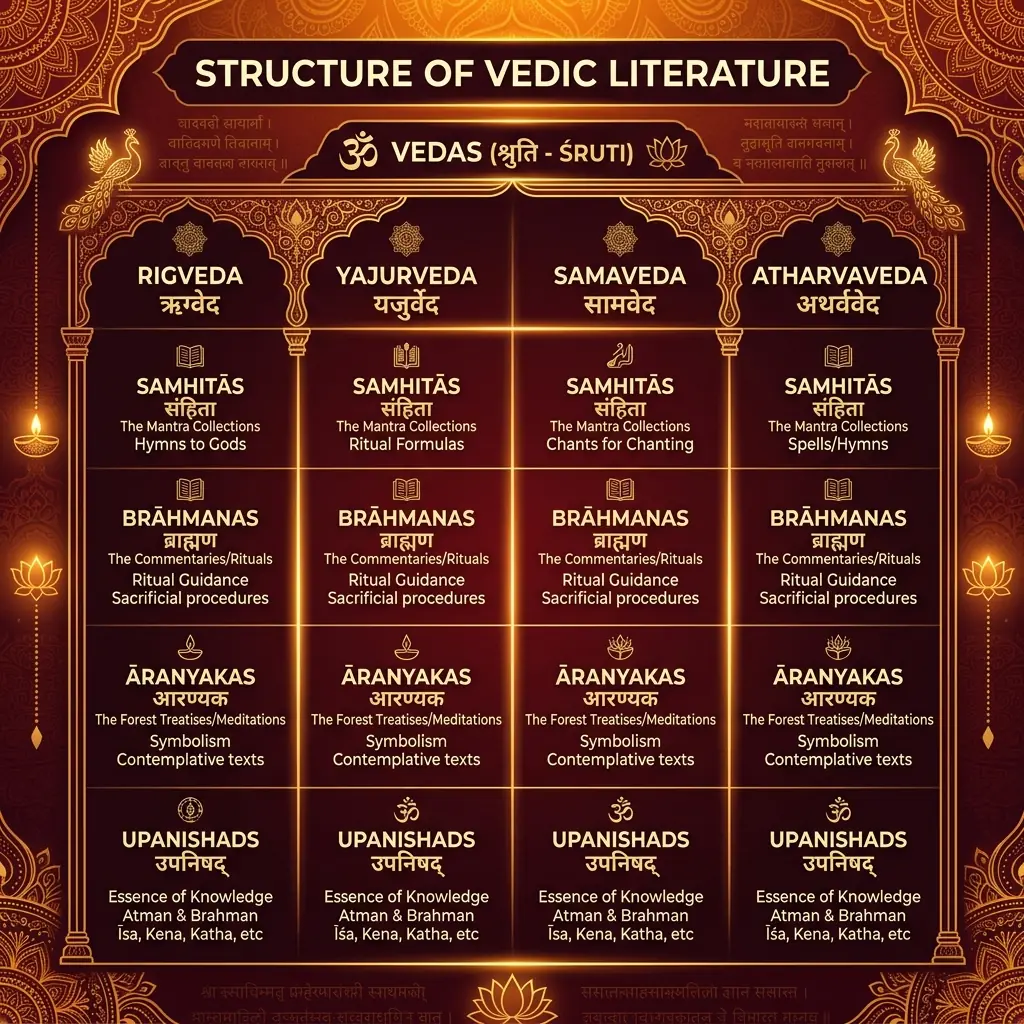
Structural subdivisions of the four Vedas: Samhita, Brahmana, Aranyaka, Upanishad
The Structural Subdivisions of Vedic Literature

Every Veda is divided into four chronological layers: the Samhita (mantras & hymns), the Brahmana (ritual explanations), the Aranyaka (philosophical meditations), and the Upanishad (pure non-dual metaphysics). The diagram above maps this fundamental architecture.

How This Page Was Prepared

This page is maintained as a clear study guide. It uses traditional structure, common scripture names, and source notes where available. When mantra or verse text is published, source and copyright details are reviewed separately.

Quick answers

Helpful Questions

How many Vedas are there?

There are four Vedas: Rigveda, Samaveda, Yajurveda, and Atharvaveda. Each has its own focus, structure, and traditional study purpose.

Where should a beginner start with Vedic study?

A beginner can start with the four Vedas overview, then move to Rigveda Mandalas, Upanishads, and Vedangas to understand the structure of Vedic learning.

What are the Vedangas?

The Vedangas are six auxiliary disciplines: Shiksha, Kalpa, Vyakarana, Nirukta, Chandas, and Jyotisha. They support pronunciation, ritual context, grammar, interpretation, metre, and time calculation.

Vikash Kumawat

Creator and maintainer

Vikash Kumawat

I maintain SanatanAdhyayan as a structured study space for readers who want to explore Vedas, Upanishads, Puranas, Itihasas, Darshanas, panchang ideas, and Vedic time concepts in a clear way.